Web Hosting for Multiple Domains (2026): Plan Limits and Real Costs
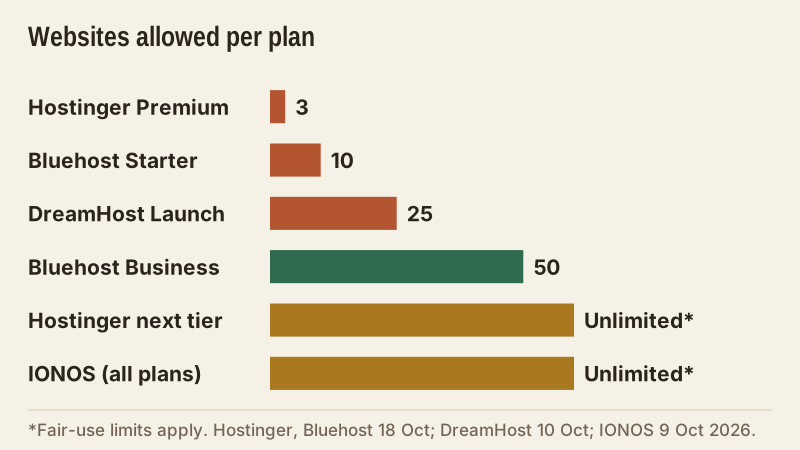
Yes, one web hosting plan can run several domains, each with its own website. The limit is set by the plan, not by the domains. On 18 Oct 2026, Hostinger's Premium plan allowed 3 websites and its next tier unlimited, while Bluehost's Starter allowed 10 and its Business plan 50. DreamHost's Launch plan listed 25 websites (read 10 Oct 2026). What grows with every site is the domain bill, because each name renews separately every year.
Put several sites on one plan when they're small, yours, and you're happy for them to share resources and a login. Split them across accounts when one is a business that shouldn't go down with a hobby site, or when someone else will own it later. This guide covers the plan limits, the difference between addon and parked domains, the yearly domain cost, and how to set it up.
How many websites each plan allows
| Host and plan | Websites | Intro price and term | Renewal | Read |
|---|---|---|---|---|
| Hostinger Premium | 3 | $2.49/mo, 48 months (Black Friday sale) | $10.99/mo | 26 Oct 2026 |
| Hostinger, next tier | Unlimited (fair use) | $3.49/mo, 48 months (Black Friday sale) | $16.99/mo | 26 Oct 2026 |
| Bluehost Starter | 10 | $3.99/mo, 36 months | $9.99/mo | 26 Oct 2026 |
| Bluehost Business | 50 | $6.99/mo, 36 months | $13.99/mo | 26 Oct 2026 |
| DreamHost Launch | 25 | $2.89/mo first year | $10.99/mo | 10 Oct 2026 (intro rechecked 26 Oct) |
| IONOS web hosting | Unlimited on all plans | $4/mo (Essential), 1-year term | $8/mo (Essential) | 26 Oct 2026 |
The entry plan is where the limits bite. Hostinger's Premium stops at three sites, so a fourth means moving up a tier, and that tier renews at $16.99 rather than $10.99. Bluehost's Starter allows ten, which covers most people running a handful of projects. DreamHost's Launch allows 25 on its cheapest plan, the most generous entry tier here. See DreamHost's plans.
One shared plan or separate plans: the arithmetic
At renewal prices the saving from sharing is large. Three small sites on one Hostinger Premium plan cost $131.88 a year at its $10.99 renewal; three separate Premium plans would cost $395.64. A fourth site pushes you to the next tier, at $16.99 a month or $203.88 a year, still well under the cost of separate plans. On Bluehost, ten sites fit on Starter at a $9.99 renewal, which is $119.88 a year. All of these are our arithmetic on the renewal rates in the table, before domains.
Separate plans earn their cost in two cases: when one site makes money and shouldn't share a fate with the rest, and when a site will be handed to someone else. For everything else, one plan with enough slots is the cheaper and simpler choice.
Addon, parked and subdomains
Control panels use three terms, and they decide whether a second domain gets its own site. An addon domain is a separate website: its own folder, its own content and usually its own email addresses. A parked or alias domain points to an existing site, so example.net shows the same pages as example.com. A subdomain, such as shop.example.com, is part of a domain you already own and doesn't need a new registration.
Plan limits are stated in websites, so pointing three spare domains at your main site as aliases shouldn't use up slots the way three separate addon sites do. Check your host's own definition before relying on it. The Enhance control panel, for example, says it doesn't bill for addon, alias or subdomains at all, only for hosted websites. To connect any of them, you point the domain's DNS at the host, as in our guide to connecting a domain to your host.
The domain bill grows with every site
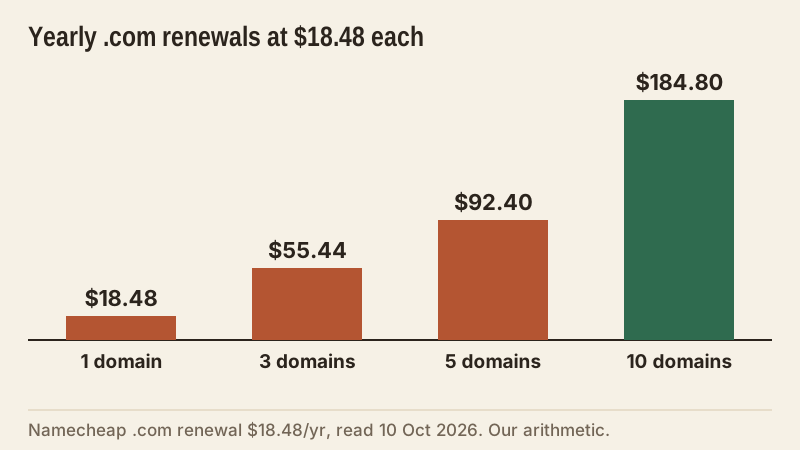
Hosting may cover ten sites for one price, but every domain renews on its own. Most hosts include one free domain for the first year with a yearly or longer plan, and the others are yours to buy. At Namecheap's .com renewal of $18.48 (read 10 Oct 2026), five domains cost $92.40 a year; at Dynadot's $10.88 the same five cost $54.40. That's our arithmetic, and it's often a bigger yearly line than the extra hosting.
Keep the domains at a registrar with low renewals and in your own name, and point them at whichever host runs the sites. Our registrars for cheap renewals compares renewal prices, and the free-domain catch explains what the bundled domain costs from year two. See Namecheap's domain prices.
What the sites share
Every site on one plan shares the same storage, memory, processing limits and file count. On Hostinger's Premium, for example, three websites share 20 GB of storage, and the plan's resource limits listed 2 GB of RAM and 400,000 inodes (read 9-10 Oct 2026). A traffic spike or a heavy plugin on one site can slow the others. Security is shared too: on many shared plans, addon sites run under the same account user, so a compromised site can expose files belonging to its neighbours.
Four habits keep a shared account healthy. Keep every site updated, because an abandoned test site is the usual way in. Delete sites you no longer use rather than leaving them online. Back up each site separately, so you can restore one without rolling back the rest. And watch the resource graphs in your panel: if one site dominates, give it its own plan.
Setting up a second domain, step by step
- Register the new domain, or transfer an existing one, in your own name.
- In your hosting panel, add it as a new website (addon domain), not as an alias, if it needs its own content.
- Point the domain's nameservers or A record at the host, following the host's DNS instructions.
- Issue the free SSL certificate once DNS has resolved, then install WordPress or upload the site.
- Create mailboxes for the new domain if you need them, and check your plan's mailbox limit first.
Allow a few hours for DNS to settle before you judge whether the setup worked, and test the new site over HTTPS from a phone on mobile data, which avoids your own cached copy. Once it loads, add the site to whatever uptime monitor and backup schedule you use for the others, so the new domain isn't the one forgotten when something breaks. Note its renewal date next to the hosting renewal too, so both bills arrive with no surprises.
Edge cases
- Client sites. Hosting a client's site in your account makes a handover messy. Put client domains in the client's name and consider reseller hosting instead. See who should own your domain.
- Unlimited sites. "Unlimited" is subject to fair use, and the plan's resource limits still apply to all sites together.
- Email per domain. Some plans count mailboxes per website and include them free only for the first year.
- One site needs more. Move the busiest site to its own plan; the domain stays put and only its DNS changes.
For the full picture of buying a domain and hosting together or apart, see our domain and hosting guide.
Multiple domains on one host: FAQ
Can I host multiple domains on one hosting plan?
What is an addon domain?
Do I have to pay for each domain?
Is it safe to put several websites on one shared account?
Which hosting plan is best for multiple websites?
Ready to get set up? See how to get a domain and hosting, or work out whether to buy them together or separately.