What Happens When a Domain Expires? The Timeline and Fees
When a domain expires, it doesn't vanish on the spot. It moves through a set of stages, and how much of your site survives depends on which one you're in. First comes a renewal grace period, when you can still renew at the normal price. Next is a 30-day redemption period, when getting it back costs a restore fee several times the renewal. Then there are a few days of pending deletion, after which anyone can register the name. Your website and email can stop working on day one, long before the name is actually lost. If you've just noticed an expired domain, log in to your registrar and renew it today: in the first stage that costs no more than any other year.
This guide follows a .com through each stage, using the rules ICANN sets for every registrar and the terms five registrars published when we read them on 9 and 10 October 2026. Country-code domains (like .uk or .de) follow their own registries' rules, so treat the timings here as the generic .com path.
What happens on day one: the site and email go dark
The first effect of an expiry is practical rather than legal: your registrar stops pointing the name at your hosting. Namecheap, for example, switches an expired domain's nameservers to its own parking servers, so visitors see a parking page instead of your site and mail to your addresses stops arriving. GoDaddy's published timeline parks the domain five days after expiry, and any connected website or email stops working then. Your hosting is untouched in both cases. The files, database and mailboxes are still on the server; only the address has stopped leading there.
That split matters for what you do next. You don't need to restore a backup or call your host, because renewing the domain reconnects everything. DNS caches can take a little while to pick up the change back, so the site may flicker for some visitors before it settles. What you do need to worry about is anything that depends on email at that domain. Password resets, two-factor codes and the registrar's own warning emails all fail if they're addressed to the very domain that just expired.
The timeline: grace, redemption, pending delete
ICANN's Expired Registration Recovery Policy, which every accredited registrar has followed since 31 August 2013, sets the frame. Before expiry, your registrar has to send two reminders, roughly a month and roughly a week ahead. It must send at least one more within five days after expiry. During the stretch when you can still renew, it has to interrupt the domain's DNS for at least the last eight consecutive days, so a lapsed name can't keep quietly working. And once a registrar deletes an expired name, the registry has to hold it in a 30-day Redemption Grace Period before it can be released.
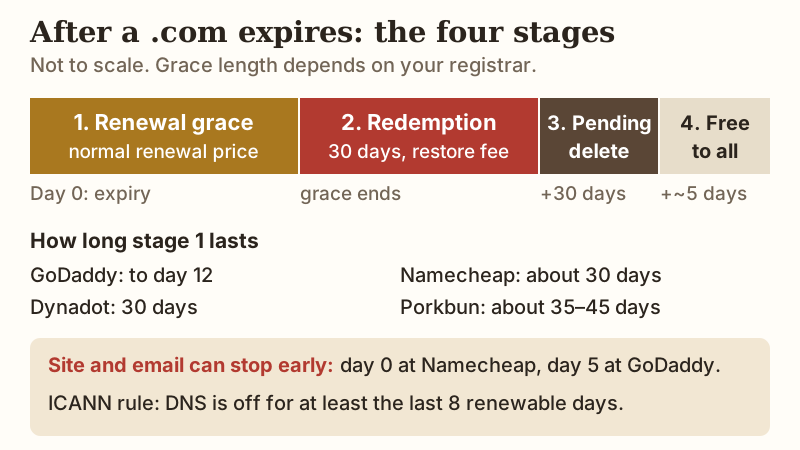
Inside that frame, each registrar sets its own grace length, and the gap between them is wide. GoDaddy lets you renew at its standard price until day 12. Namecheap gives about 30 days for .com and similar extensions. Dynadot's .com page lists a 30-day renewal grace period. Porkbun keeps the normal renewal price until somewhere between day 35 and day 45, typically around day 37 or 38. After grace comes redemption: 30 days in which you can still recover the name, but only by paying a restore fee on top. Then comes pending delete, typically about five days for a .com, after which the name drops and anyone can register it. GoDaddy runs its own sequence in this window, offering expired names at auction from day 26 and removing them from your account entirely at day 72.
Recovery fees by registrar
The restore fee is where an expired domain gets expensive, and it's also the number registrars are least keen to print. Here's what each of the five published, or didn't, when we checked.
| Registrar | Renew at the normal price until | Site and email stop | Restore (redemption) fee | Notes |
|---|---|---|---|---|
| GoDaddy | Day 12 | Day 5 (domain parked) | $99.99 from day 18 (its standard price; GoDaddy says actual prices may vary) | Renewal $22.99; auctions from day 26; removed from your account at day 72; redemption fees non-refundable |
| Namecheap | About day 30 | Day 0 (parking page) | Not published in its help article, plus a $0.20 ICANN fee | Then a 30-day redemption period |
| Dynadot | Day 30 | Not stated on its .com page | $100.92 | Renewal $10.88; 30-day restore window |
| IONOS | Not confirmed | Not confirmed | $90 | Renewal $20; transfer $9.50 |
| Porkbun | About day 35–45 (often day 37 or 38) | Not stated | Renewal plus a registry redemption fee; amount not published | Then pending delete |
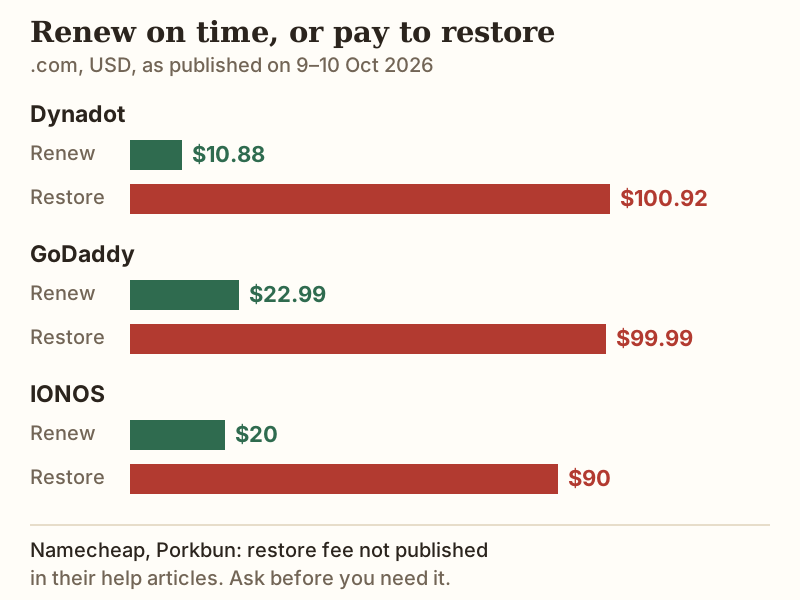
Three registrars print the figure. Dynadot's .com page lists a restore price of $100.92 against a $10.88 renewal, GoDaddy's fee table a $99.99 redemption fee against a $22.99 renewal, and IONOS's price table a $90 restore fee against a $20 renewal. So missing the grace window costs roughly four to nine times a normal year. Namecheap's help article explains that the redemption fee is set by its upstream registrar and the domain registry, but it gives no amount. Porkbun says the fee varies by registry. GoDaddy's refund policy, for its part, rules out getting a redemption fee back. If your domain sits with Namecheap or Porkbun, ask support for the current figure before you ever need it, and don't assume it will be small.
The practical lesson is that timing beats price. A domain renewed on day 3 costs the same as one renewed a month early. The same domain renewed on day 40 can cost a hundred dollars. Whichever registrar you use, the grace window is the one you want to act inside.
When the expired domain was registered by your host
A domain that came free with a hosting plan carries extra risks, because the renewal runs through the host's billing rather than a registrar account you watch. The free year ends on a date unrelated to your hosting term, which might be prepaid for three or four years, so the domain can lapse while the hosting is fully paid. The renewal is charged to whatever card the host has on file, and an expired card fails silently if the warning emails go to an inbox on the domain itself. If you cancelled the hosting, you may also find the domain was tied to that account in ways that make renewing it awkward.
The fix is the same either way. Log in to the host's dashboard, find the domain section and renew. If the host made you the registrant, the domain is yours to renew and, once it's healthy again, to move. Once the domain is active again, consider transferring it to a registrar you manage directly. A transfer adds a year to the registration and puts every future renewal in an account you control. The transfer guide walks through it, and who should own your domain explains how to check you're the registrant before anything goes wrong.
What if you don't have a domain name at all?
People sometimes search this from the other direction: what actually happens if you never buy a domain? Nothing breaks, because a domain is optional. Most hosts give you a temporary address or a subdomain on their own name, which works for building and testing. You simply can't hand anyone a short, memorable address of your own, and you can't have email at a name you control. The bigger risk is the gap between letting a name expire and deciding you want it back. Once the deletion stage passes, the name is open to anyone. If the name matters to your brand, keeping it renewed costs far less than buying it back. Our explainer on whether you need hosting to own a domain covers the opposite case, owning a name with no site.
How to never lose a domain
Most expired domains weren't abandoned. They were forgotten, or the payment failed. Five habits close nearly every gap, and they take about ten minutes to set up.
- Turn on auto-renew at the registrar, and check the setting again after any transfer.
- Keep a current card on file, and update it the day you get a replacement card.
- Use an email address off the domain for the registrar account, such as a personal mailbox, so reminders and resets still arrive when the domain is down.
- Register for several years at once for a name you depend on, so a single missed charge can't take it out.
- Put the expiry date in your calendar with a reminder a month ahead, the same timing ICANN requires of the registrar.
If you're choosing where the domain should live, a registrar that prints its renewal and restore prices lets you see the worst case in advance. When we checked, Dynadot charged $10.88 a year for .com with a published $100.92 restore price, and IONOS listed a $20 renewal and a $90 restore fee. Namecheap documents its grace and redemption stages clearly, even though it doesn't print the fee. Any of the three, with auto-renew on and an off-domain email address, makes an accidental expiry very unlikely. Whether a host's free domain or a separate registrar suits you better is weighed up in our domain and hosting guide.
Expired domains, answered
What happens when a domain expires?
Can I get my domain back after it expires?
How long after a domain expires can someone else buy it?
Will I lose my website files if my domain expires?
What is a domain redemption period?
Ready to get set up? See how to get a domain and hosting, or work out whether to buy them together or separately.